
Sustainable land management requires balancing land use with conservation and ecosystem impacts. While synthetic herbicides are often perceived as less sustainable or more ecologically damaging than physical alternatives, their efficacy and low cost make them highly practical for controlling persistent species like Japanese Knotweed. Traditionally, environmental impact assessments focus only on the ‘post-application’ phase (environmental fate), ignoring the broader life cycle of the management tools themselves.
Brief
The project aimed to:
Conduct the first-ever comparative Life Cycle Assessment (LCA) for Knotweed management methods.
Evaluate the environmental and economic impacts of both chemical and physical control approaches across their entire life cycle – from raw material extraction and production to transport and use.
Provide a holistic framework for defining ‘sustainable environmental stewardship’ in the context of invasive species management.
What we did
The research team applied a rigorous LCA methodology to a large-scale field study model:
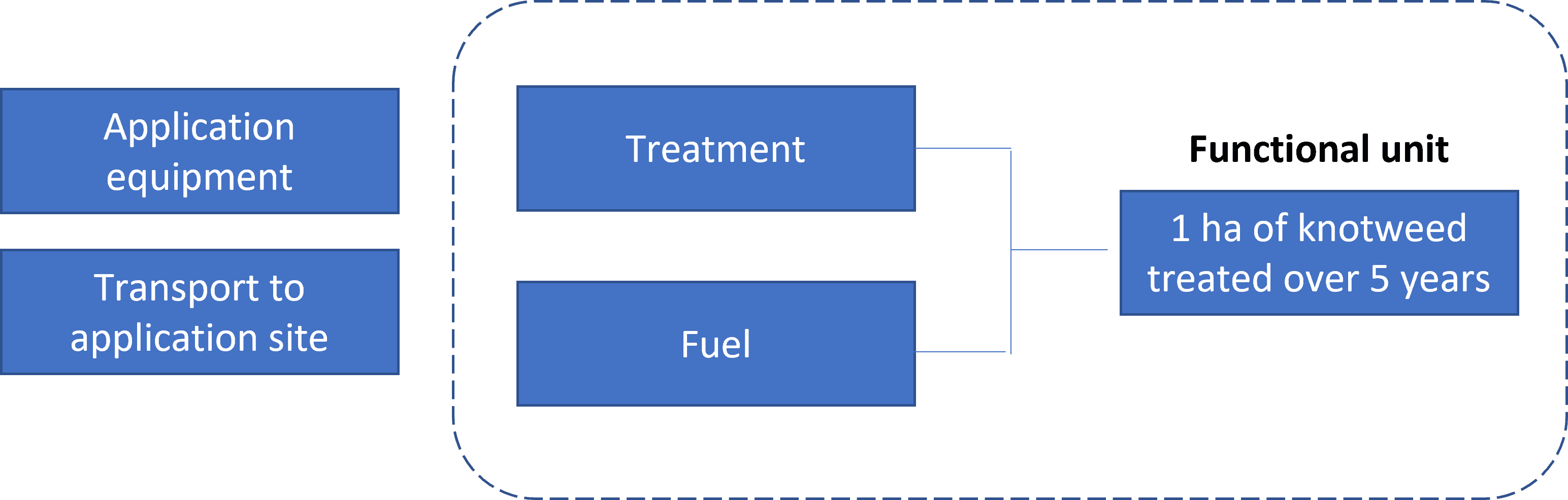
Holistic impact – the study accounted for every stage of the management lifecycle, including raw material extraction, formulation, packaging, storage, and transport.
Comparative modelling – the team compared industry-standard glyphosate-based treatments against popular physical alternatives, such as geomembrane covering and integrated physiochemical methods.
Sustainability benchmarking – by integrating efficacy data with environmental and economic costs, the study challenged the conventional wisdom that ‘non-chemical’ automatically equals ‘more sustainable’.
Key Outcomes
The findings provided a paradigm shift in how sustainable management is measured:
Chemical efficacy & sustainability – glyphosate-based methods were found to elicit the lowest environmental impacts and the lowest economic costs across the full life cycle.
The hidden cost of physical control – geomembrane covering and integrated physiochemical methods were identified as the costliest and imposed the greatest environmental impacts, largely due to the high energy and resource requirements of manufacturing and transporting the materials involved.
Defining sustainability – the research demonstrated that control methods that are economically unsustainable or ineffective are, by definition, environmentally unsustainable.
Scientific publication – the work was published in Nature Scientific Reports (2023), providing a high-impact, peer-reviewed evidence base for land managers and policymakers.
Summary
This groundbreaking study provides the first real-world, field-based Life Cycle Assessment (LCA) focussing on treatments for invasive plant control. By proving that glyphosate-based treatments are both more effective and more environmentally sustainable than material-heavy physical alternatives, the research offers a definitive framework for evidence-led decision-making. It highlights that true environmental stewardship must account for the total ecological footprint of a management method, rather than just its impact at the point of application.