
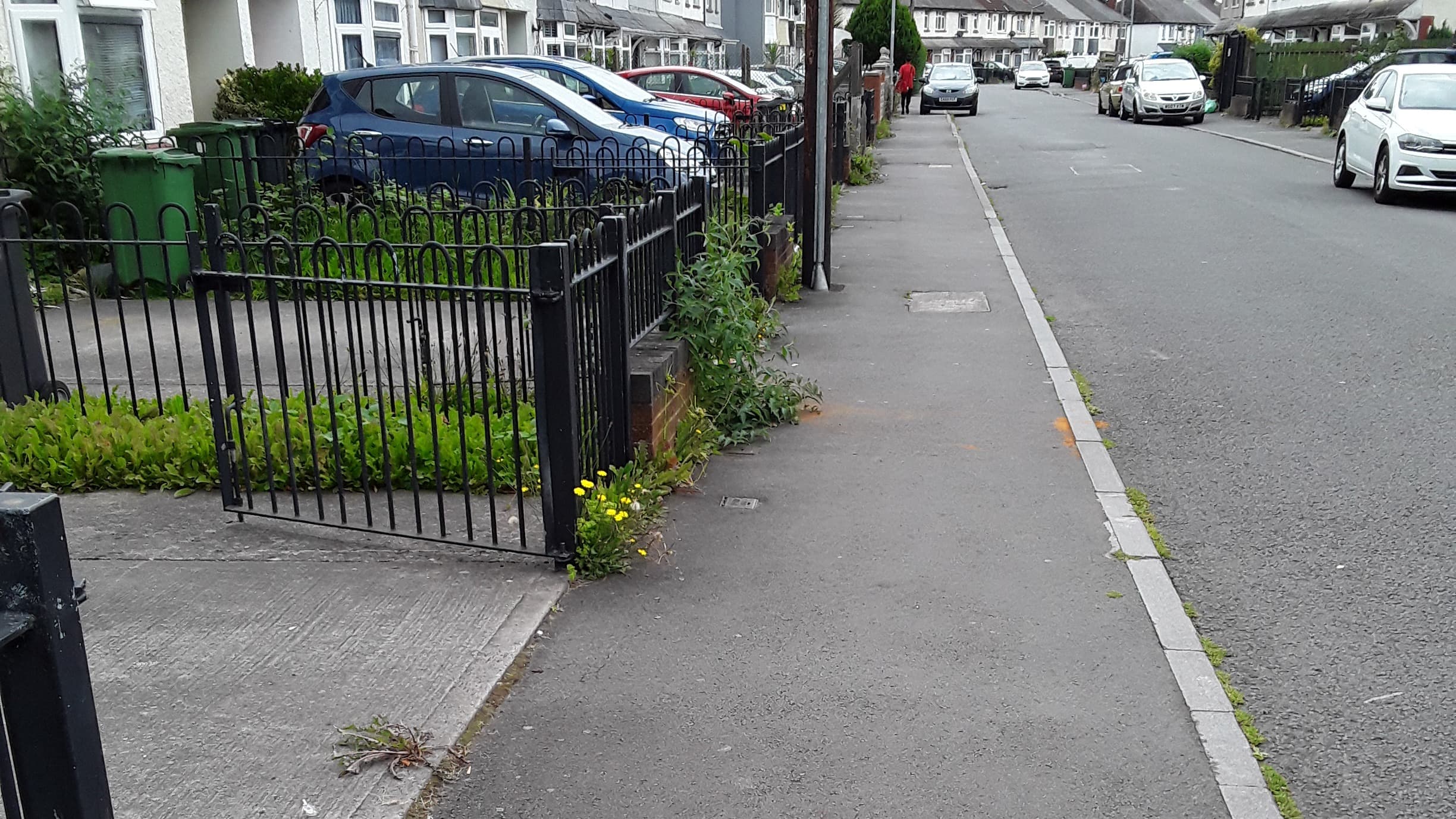
Following an Environmental Scrutiny inquiry into biodiversity management, Cardiff Council sought to determine if they should transition away from glyphosate-based weed control to ‘greener’ alternatives. The council needed an evidence-based assessment to balance public concerns about herbicides with the practicalities of maintaining city infrastructure.
Brief
Advanced Invasives (Ai) was commissioned to conduct a rigorous, independent trial comparing the sustainability, cost-effectiveness, and quality of three pavement weed control methods across the City of Cardiff.
What we did
The trial, led by Dr Daniel Jones, compared three distinct approaches:
Glyphosate – applied using precision WEED-IT technology (infrared sensors that only spray when a weed is detected).
Acetic acid – high-concentration vinegar-based herbicide, applied using WEED-IT technology.
Hot foam – plant-based foam combined with boiling water applied by hand.
Key findings included:
Resource use – hot foam required 65 times more water and 63 times more diesel fuel per kilometre than glyphosate.
Product volume – acetic acid required 16 times more product (16.25 litres vs 1.05 litres for glyphosate) to achieve similar results.
Labor & efficiency – glyphosate required only 0.16 hours of labour per kilometre, whereas hot foam required nearly 5 hours, making it significantly more expensive and disruptive.
Public satisfaction – glyphosate generated the fewest public complaints (4), compared to 29 for hot foam, primarily due to the visible effectiveness and speed of the treatment.
These data were subsequently modelled by Dr Trisha Toop and Dr Sophie Hocking to provide Life Cycle Analysis of each product across 18 environmental impact categories.
Key Outcomes
The study concluded that, when accounting for the full environmental ‘life cycle’ (fuel, water, and transport), glyphosate was the most sustainable option currently available in the UK. It offered the lowest environmental impact in 16 of the 18 categories tested.
As a result, Cardiff Council opted to continue its targeted glyphosate programme, providing a scientific shield against political and public pressure to switch to less efficient, more resource-intensive ‘alternative’ methods. This study now serves as a primary reference point for local authorities across the UK facing similar management decisions.
Summary
In response to an Environmental Scrutiny inquiry and mounting pressure to phase out herbicides, Advanced Invasives conducted a rigorous, independent trial for Cardiff Council to evaluate the sustainability, cost-effectiveness, and quality of glyphosate, acetic acid, and hot foam for city-wide pavement weed control. By performing a comprehensive life cycle assessment across 18 environmental impact categories, the study revealed that precision-applied glyphosate (via infrared WEED-IT technology) was the most sustainable option, requiring 65 times less water and 63 times less diesel fuel per kilometre than hot foam, while also proving to be significantly more labour-efficient and generating the fewest public complaints. These findings provided Cardiff Council with an evidence-based rationale to continue its targeted glyphosate program, demonstrating that when the full environmental and operational life cycle is considered, high-tech herbicide application currently offers the lowest overall impact for maintaining urban infrastructure.