
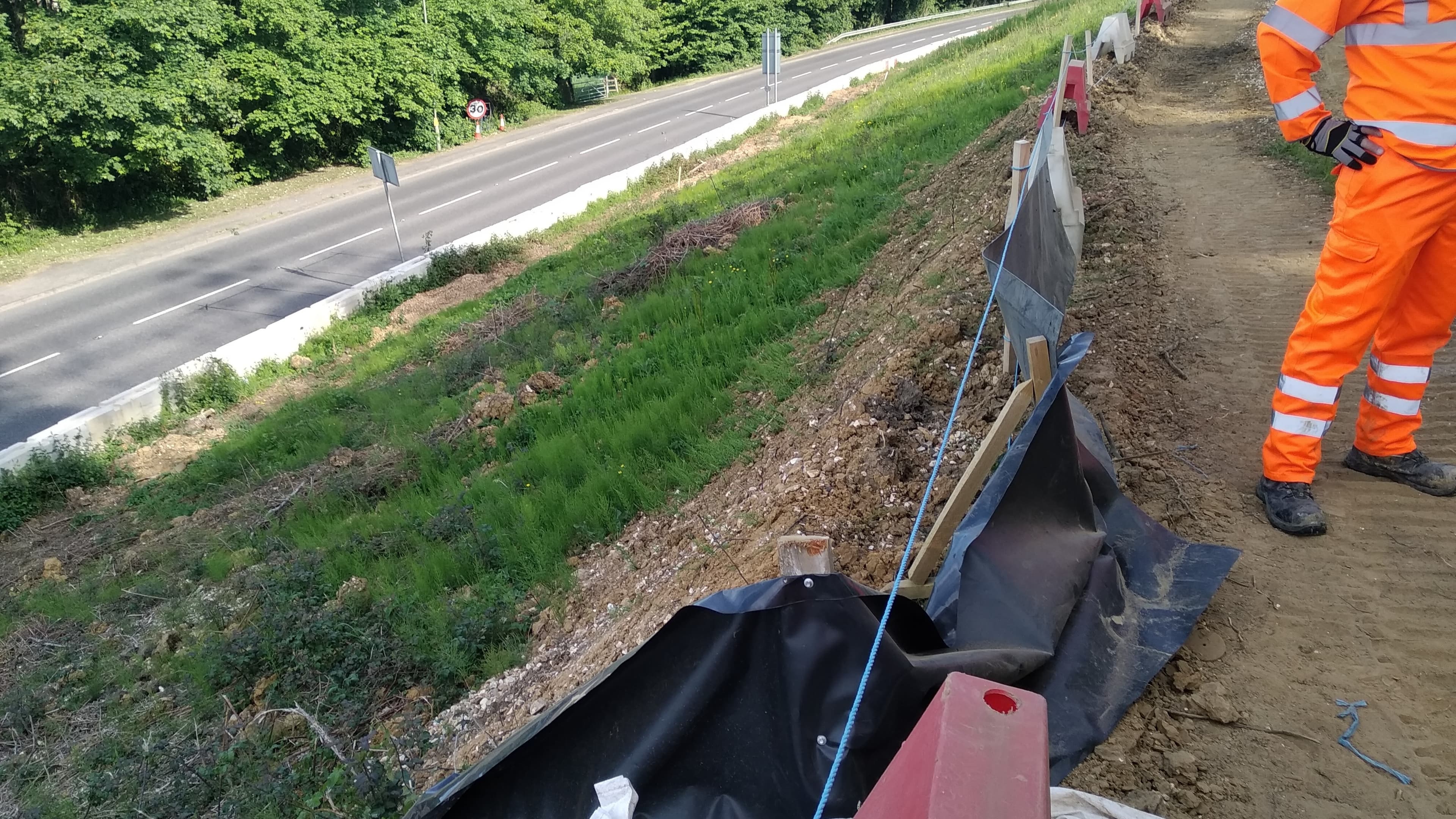
BAM Nuttall required specialist advice for a road construction project where Field Horsetail was widespread. This infestation complicated works delivery, creating a ‘residual risk’ of spreading the plant across the new assets, and was also likely to create third-party liability for the client in the long-term.
Brief
Advanced Invasives (Ai) was commissioned to:
Develop a Biosecurity Method Statement to manage the risk of spreading rhizomes (roots) and spores (seeds) during groundworks.
Provide phased treatment recommendations for immediate to long-term control.
Identify long-term constraints and provide remediation options to ensure the project's sustainability and asset integrity.
What we did
The team conducted a technical species-profile assessment and developed a ‘biosecure’ operational workflow:
Feasibility assessment – determined that eradication was unfeasible due to the species' depth (up to 6m) and spore-based reproduction, shifting the project goal to sustainable management and containment.
IPM – developed a phased Integrated Pest Management (IPM) approach using specific herbicides (glyphosate, 2,4-D amine, and MCPA) timed to the plant’s biological ‘source-sink’ switch.
Biosecurity zoning – designed a system to designate ‘clean’ and ‘dirty’ areas, with specific procedures for vehicle clean-down areas.
GIS integration – mandated that all material excavation, disposal, and reuse areas be marked electronically on a GIS to enable precise follow-up treatments.
Key Outcomes
The strategy provided the client with a scientifically robust roadmap to manage a notoriously difficult species without stopping construction works.
Spread prevention – the biosecurity framework effectively minimized the risk of the plant spreading via vegetative fragments during cut-to-fill operations.
Targeted treatment – the use of specific herbicide active ingredients (Glyphosate, 2,4-D, and MCPA) weakened the population and reduced the density of emergent growth.
Asset protection – by moving to a data-led management model, the project avoided the long-term maintenance costs and structural damage typically associated with unmanaged Horsetail encroachment on road surfaces and footways.
Project value
£0
Sectors
Summary
On behalf of BAM Nuttall and Hampshire County Council, Advanced Invasives developed a comprehensive biosecurity and management strategy to address the widespread presence of Field Horsetail on a major road construction project. Recognising that the species' deep-reaching rhizomes (up to 6m) made total eradication unfeasible, the team implemented a strategic shift toward containment and sustainable management. By combining a strict ‘clean and dirty’ biosecurity zoning system with biologically timed Integrated Pest Management (IPM) treatments and GIS-mapped excavation protocols, the project effectively minimised the risk of spreading the plant during complex cut-to-fill operations. This data-led approach successfully protected the new infrastructure from future structural damage and third-party liabilities, ensuring long-term asset integrity without disrupting the construction schedule.