
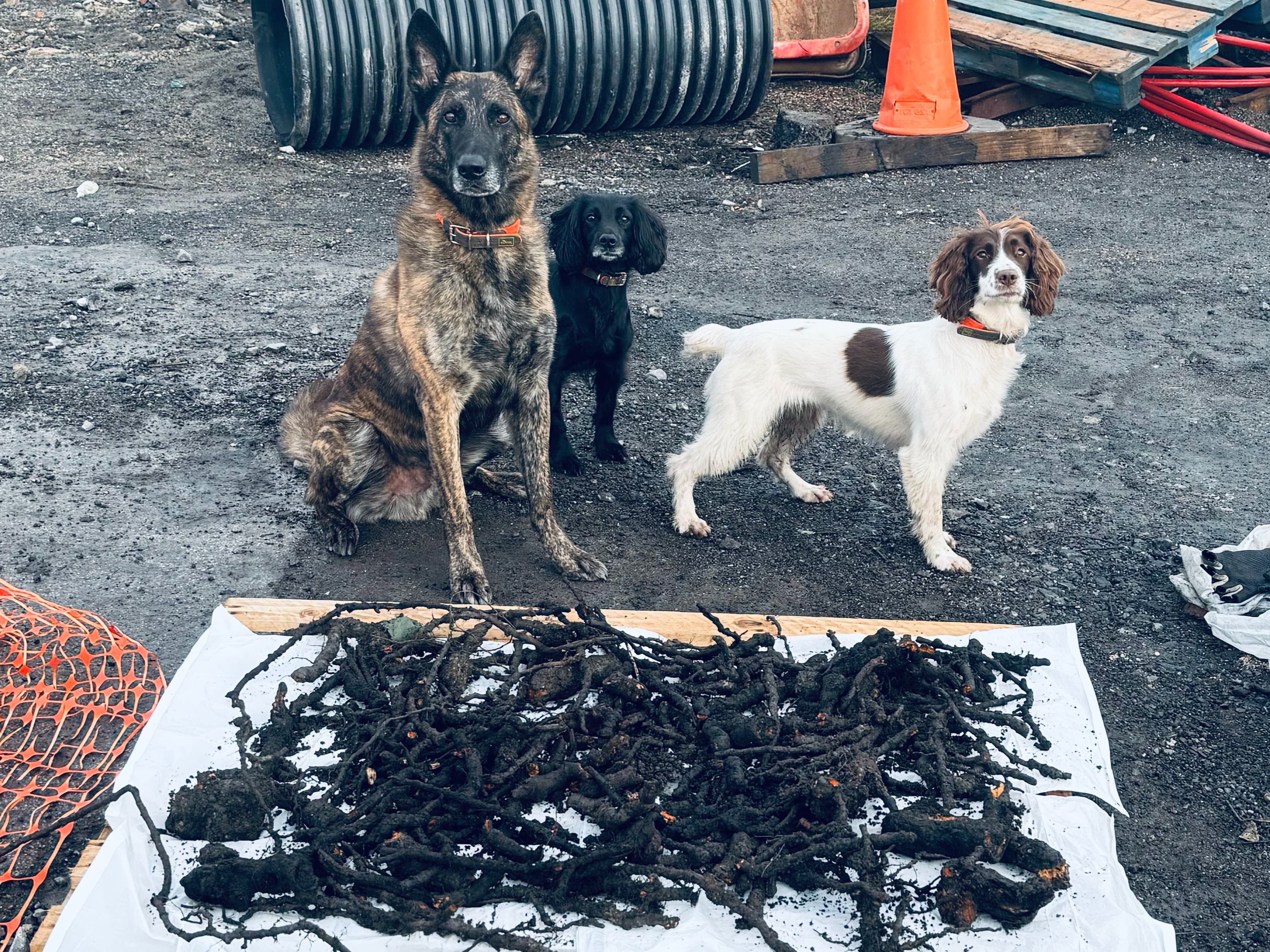
Brownfield site development in South Wales is frequently complicated by the presence of Japanese Knotweed and other invasive plants. This project focused on a 0.5-hectare brownfield site slated for housing. It appeared to have minor Japanese Knotweed issues, but its industrial history suggested deeper contamination.
Brief
Complete Weed Control (CWC) was engaged by the site groundwork contractor to provide Knotweed remediation services. Concerns regarding site treatment history and Knotweed extent led CWC to engage Advanced Invasives (Ai) to:
Investigate the site forensically to resolve discrepancies in Japanese Knotweed growth.
Provide bespoke mitigation solutions and a robust Knotweed Management Plan (KMP).
What we did
Ai used a multi-layered investigative approach to reveal the true biological and environmental condition of the site:
Historical imagery analysis – utilised historical aerial photography to determine that Knotweed had previously covered approximately 20% of the site, establishing a baseline for expected contamination.
Forensic site investigation – performed detailed visual inspections and trial pit excavations. While these initial checks failed to locate significant growth, they highlighted the need for higher-sensitivity detection methods.
Canine scent detection – engaged world-leading scent detection services (Canine Detection Solutions). Specialist dogs identified living Knotweed rhizomes (roots) across 2,031m² – over 100 times the 20m² area suggested by standard visual surveys.
Remediation audit – the investigation revealed that a previous contractor’s ineffective treatment had effectively cross-contaminated the entire site with Knotweed fragments and hazardous pollutants, including asbestos and heavy metals.
Key Outcomes
Remediation strategy & KMP – the forensic investigation provided the evidentiary foundation for a robust Knotweed Management Plan (KMP), transitioning the project from a reactive ‘quick-fix’ approach to a scientifically valid, ‘best practice’ remediation strategy tailored to the site’s complex industrial history.
Forensic accuracy – by identifying living rhizomes across an area 100 times larger than visual surveys suggested (2,031m² vs 20m²), the analysis ensured that all remediation efforts were based on biological reality, preventing future regrowth from overlooked contamination.
Risk management & liability – provided the critical forensic evidence required to prove that previous site mismanagement and ineffective treatment had caused widespread cross-contamination, allowing for the clarification of legal and financial liability before construction commenced.
Financial certainty – quantified how the failure to address effective mitigation prior to construction escalated potential remediation costs from £80,000 to £2,700,000, allowing the client to accurately budget for necessary environmental safeguards and long-term asset protection.
Project value
£0
Sectors
Summary
Advanced Invasives were engaged to perform a forensic site investigation to resolve discrepancies in Japanese Knotweed growth on a 0.5-hectare brownfield housing development site in south Wales (UK). By integrating historical aerial imagery and world-leading scent detection services from Canine Detection Solutions, the team revealed that living Knotweed rhizomes (roots) were present across 2,031m² – over 100 times the area suggested by visual surveys alone. The investigation proved that previous treatment by a Knotweed contractor had effectively cross-contaminated the entire site with Knotweed fragments and hazardous pollutants including asbestos and heavy metals. This forensic evidence demonstrated how site mismanagement escalated potential remediation costs from £80,000 to £2,700,000, underscoring the vital economic and environmental necessity of expert-led mitigation prior to the construction phase.