
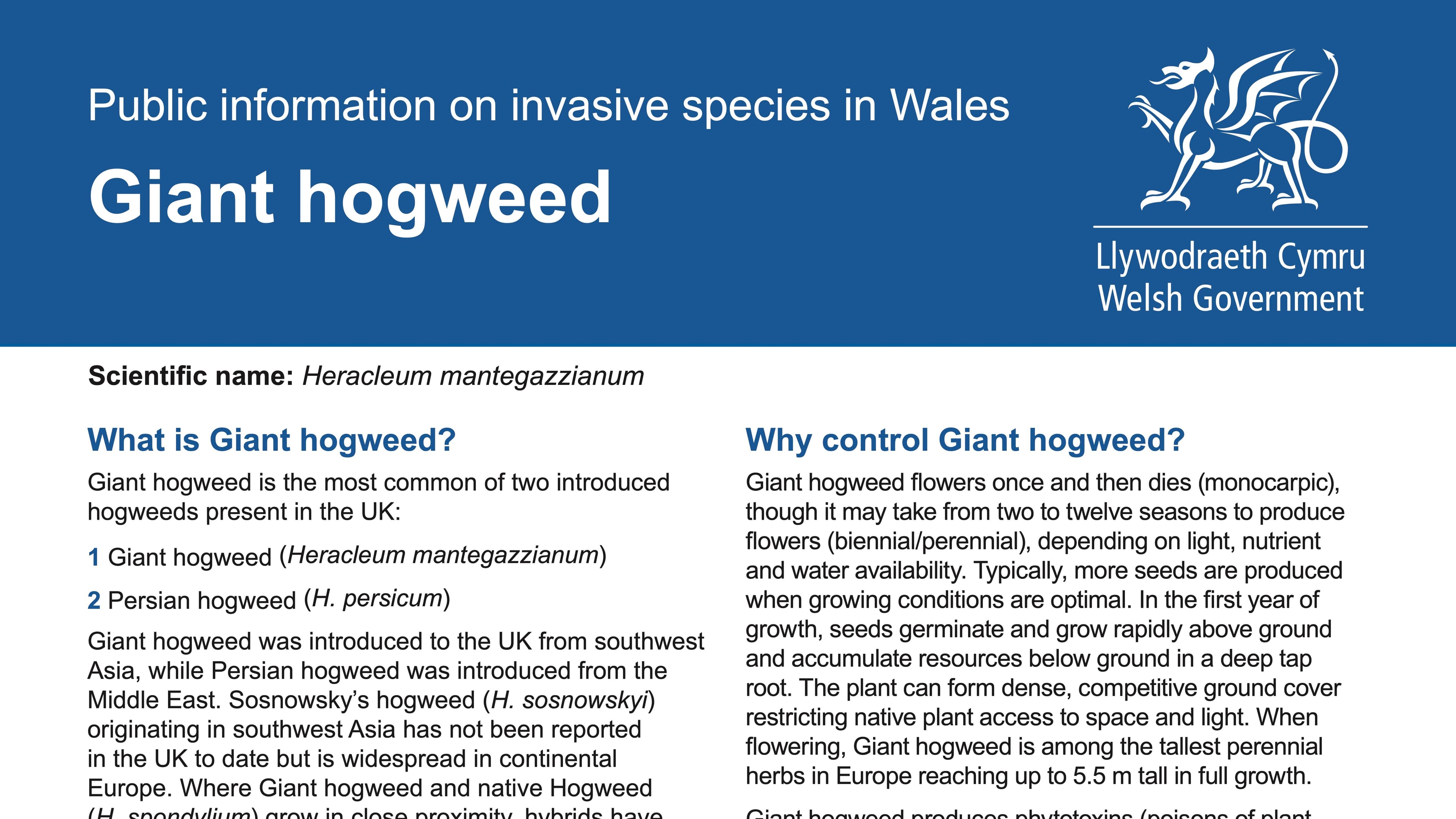
Before these documents, Japanese Knotweed, Himalayan Balsam and Giant Hogweed management in the UK was largely based on anecdotal ‘best practice’. Advanced Invasives utilised its dedicated research facility, ai:LAB, to provide the empirical data needed to set new national standards.
Brief
The Welsh Government required a suite of standalone, modular guides to:
Stop ‘well-intentioned failure’ – limit community groups and landowners from using methods (e.g. cutting Knotweed and/or spraying it at the wrong time) that research showed were ineffective.
Deploy ‘fast-track’ science – use the latest (including unpublished) research from ai:LAB to address the immediate threat of Giant Hogweed and Himalayan Balsam.
Provide a legal benchmark – establish a standard of care that could be cited in court as the ‘current state of the science’.
What we did
The project integrated two distinct research streams into four standalone guides:
Japanese Knotweed (Jones et al. 2018) – translated the 19-method field trial into two guides (Public Info & Practical Control) that mandate late-season glyphosate application as the only statistically proven long-term management solution.
Himalayan Balsam & Giant Hogweed (ai:LAB Research) – application of commercial R&D to provide Integrated Pest Management (IPM) solutions for managing and/or eradicating these species at all scales.
Operating procedures – every guide independently carries requirements for biosecurity and risk assessment, ensuring that a volunteer picking up any of the four documents has the full set of tools for a safe, compliant project.
Key Outcomes
This suite of four documents has created a ‘protected’ evidence base at the Wales-level:
Global best practice – these are currently the only evidence-based guides of their kind in the world, placing Wales at the forefront of invasive species management.
Commercial to policy transfer – use of ai:LAB's unpublished and commercial research allowed the Welsh Government to implement cutting-edge techniques years ahead of other jurisdictions.
Economic resilience – by providing a standalone ‘Public Info’ guide for Japanese Knotweed, the project directly stabilised the Welsh property market, enabling surveyors and lenders to move away from ‘blight’ toward ‘informed management’.
Public safety – the Giant Hogweed guide has become the definitive health and safety standard for local authorities, significantly reducing the liability associated with ‘phytophotodermatitis’ (skin blistering) in public spaces.
Summary
Commissioned by the Welsh Government, Advanced Invasives leveraged its ai:LAB research facility to replace anecdotal ‘best practice’ with a suite of four standalone, evidence-based guides for the identification and management of Japanese Knotweed, Himalayan Balsam, and Giant Hogweed. By translating years of empirical research into practical protocols – including the mandate for late-season glyphosate application as the only proven long-term solution for Knotweed – the project established a critical benchmark for the ‘current state of the science’ that informs public and private sector management ‘best practice’. This strategic intervention positions Wales as a global leader in scientifically sound invasive species management policy.